The transition of global commerce toward a decentralized and remote-first model has fundamentally altered the requirements for corporate identity and administrative permanence. Within this environment, VirtualPostMail (VPM) has emerged as a critical infrastructure provider, bridging the gap between digital operations and the rigid physicality required by legal and financial regulatory frameworks. Originally founded in 2009 to solve the personal and business mail management challenges of remote business owners, the organization has evolved into a multi-state operation focusing on California, Delaware, Florida, Nevada, and Texas. This expansion is driven by a strategic alignment with search trends that prioritize business verification, state-level tax optimization, and high-security compliance standards such as SOC 2 Type II and HIPAA.
Key Insights for Enterprise Stakeholders:
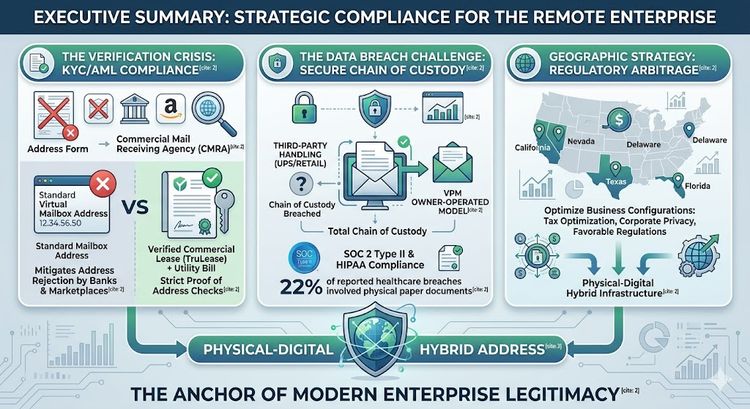
- The "Verification Crisis" Solved: Standard mailbox addresses (CMRAs) are frequently rejected by automated financial systems and marketplaces like Amazon. VPM's specialized TruLease service mitigates this by providing authenticated commercial office leases and utility bills to satisfy stringent "proof of address" checks.
- Mitigating Data Breaches: With approximately 22% of reported healthcare data breaches over the past 24 months originating from physical paper mail, VPM leverages an owner-operated model. Unlike marketplace competitors that outsource mail to third-party retail stores, VPM maintains complete chain of custody under universal SOC 2 Type II and HIPAA-compliant standards.
- Regulatory Arbitrage & Geographic Strategy: By establishing physical operations in business-friendly jurisdictions—specifically California, Delaware, Florida, Nevada, and Texas—the platform enables organizations to optimize tax configurations, protect corporate privacy, and maintain compliance seamlessly.
The Geographic Strategy of Regulatory Arbitrage
The search volume associated with VirtualPostMail is heavily concentrated in states with favorable business climates. The organization's physical presence in Nevada, Delaware, California, Florida, and Texas is a direct response to user demand for "tax-friendly" and "privacy-centric" jurisdictions.²
The Nevada/Henderson Hub and Privacy Protections
Nevada has established a reputation as a primary destination for remote entrepreneurs, characterized by searches for "Nevada virtual address" and "Nevada LLC tax benefits".¹⁵ The Henderson facility serves as a central processing hub, offering unique suite numbers that are not shared across a marketplace of third-party providers, a distinction that enhances security and reliability.¹⁴ Nevada is particularly attractive due to its lack of state income tax and the existence of a dedicated business court system designed to resolve commercial disputes efficiently.¹⁸ Furthermore, Nevada business law allows for significant privacy, permitting LLC owners to remain unnamed in public registration filings, which aligns with VPM's emphasis on protecting personal home addresses.¹⁸
The Delaware Legal Standard
For businesses seeking outside investment or corporate prestige, Delaware remains the dominant search target. VPM's presence in Delaware addresses the requirements of venture-backed startups that utilize the Delaware Court of Chancery for its sophisticated handling of complex corporate litigation.¹⁶ Searchers looking for "Delaware virtual office" often discover VPM as a more cost-effective alternative that still provides the necessary physical nexus for incorporation and registered agent services.²
Table 2: Comparative Analysis of Primary Hub Jurisdictions
| State | Primary Strategic Advantage | VPM Presence |
|---|---|---|
| Nevada | No state income tax; strong privacy laws.¹⁷ | Henderson, Nevada |
| Delaware | Sophisticated Court of Chancery; investor preference.¹⁶ | Claymont, Delaware |
| California | Proximity to tech hubs; massive economic zone.¹ | Covina, California |
| Florida | Popular for expats and retirees; no income tax.² | Brandon, Florida |
| Texas | High-growth business environment; no income tax.² | Heartland, Texas |
Solving the Verification Crisis
A significant portion of search traffic is driven by the increasing rigor of the "Know Your Customer" (KYC) and "Anti-Money Laundering" (AML) regulations. Traditional virtual mailboxes, classified by the USPS as Commercial Mail Receiving Agencies (CMRAs), are increasingly flagged by automated systems at major banks and e-commerce platforms like Amazon.⁵ This has created a specialized search niche for "non-CMRA addresses" and "physical address with lease".⁵
TruLease and the Amazon Seller Verification Problem
Since the implementation of the INFORM Consumers Act and stricter Amazon seller verification protocols in 2020, simple mailbox addresses are often rejected during the account setup or verification process.⁵ Amazon frequently requires a signed lease agreement and a utility bill in the name of the business or owner.⁵ VPM's TruLease service was developed as a direct response to this market need, providing a commercial office lease in a building that is not registered as a coworking space or virtual office provider.⁷
This service allows entrepreneurs to undergo Amazon's mandatory video verification calls with the necessary documentation, including utility bills in the lessor's or business's name.⁵ The search trend for "utility bill for Amazon address" has become a primary driver for TruLease adoption, as it effectively solves the "proof of address" hurdle that stops many remote businesses from scaling.⁵
Banking Compatibility and the CMRA Stigma
The financial sector presents a similar challenge. User searches often involve "banks that accept virtual addresses," leading to an understanding that while a mailbox works for correspondence, a physical lease is often required for account opening and maintenance.⁸ VPM's ability to provide both a mailing address and a physical lease through TruLease positions it uniquely to handle the diverse requirements of the banking industry.⁷
Healthcare and Legal
VirtualPostMail has identified and captured search demand from highly regulated industries that require more than just basic mail scanning. This is evidenced by the organization's pursuit of SOC 2 Type II and HIPAA compliance.¹
The Digital Mailroom for Healthcare
In the healthcare sector, approximately 22% of reported breaches in the last 24 months involved paper documents.³ Traditional physical mailrooms are inefficient and prone to human error, leading to delays in billing, authorizations, and patient care.³ Healthcare providers search for "HIPAA compliant virtual mailbox" to mitigate these risks. VPM's digital mailroom solution offers end-to-end encryption, real-time audit trails, and the ability to sign a Business Associate Agreement (BAA), which is mandatory for entities handling Protected Health Information (PHI).³
The transition to a digital mailroom allows healthcare organizations to:
- Securely digitize insurance documents and patient records.³
- Route critical documents to the correct department on the same day they are received.³
- Reduce manual labor costs associated with sorting and shredding physical paper.³
- Support hybrid and telehealth models where teams are geographically distributed.³
Statutory Compliance and the Registered Agent
Every LLC and Corporation is legally required to designate a registered agent available during normal business hours to receive service of process and state correspondence.² A common search query is "free registered agent service," which VPM leverages by including this service at no additional cost for all virtual mailbox plans in its active states.¹ This saves business owners approximately $100 or more annually and ensures that time-sensitive legal documents are scanned and available for online review the same day they are received.⁶ Using a commercial registered agent also prevents the business owner's personal home address from becoming part of the public record, a major privacy concern for many remote founders.²
Operational Architecture and the Owner-Operator Advantage
A significant differentiator for VPM in search comparisons is its "owner-operator" model. Unlike marketplace competitors such as iPostal1 or Anytime Mailbox, which partner with third-party pack-and-ship stores, VPM owns and operates its own processing centers.¹⁴ This vertical integration is a central theme in search results related to "virtual mailbox security" and "mail handling quality".¹⁴
Table 3: Vertical Integration vs. Marketplace Models
| Feature | VirtualPostMail (Owner-Operator) | Marketplace (iPostal1 / Anytime Mailbox) |
|---|---|---|
| Chain of Custody | Mail is handled exclusively by trained VPM employees on-site.¹⁴ | Mail is handled by independent third-party contractors at retail locations.¹⁴ |
| Security Standards | Universal standards across all locations; SOC 2 and HIPAA.¹⁴ | Inconsistent; policies vary from one address to the next.¹⁴ |
| Processing Speed | Same-day or 1-business-day turnaround for most requests.¹¹ | Variable; dependent on the efficiency of the local store owner.²⁸ |
| Service Range | Offers TruLease and TruResidence because it controls the property.¹² | Primarily limited to mailbox services.³⁰ |
| Public Access | Locations are closed to the public; no local pick-up for security.⁸ | Often retail stores with high public traffic; local pick-up allowed.²⁹ |
The Workflow of Digitization
The lifecycle of a piece of mail involves several distinct stages that emphasize both speed and data security:
- Receipt and Notification: Mail arrives at a secure VPM center and an exterior scan of the envelope is uploaded, triggering an email notification to the user.⁸
- Request for Action: Users view the envelope scans via a web browser and decide whether to open and scan the contents, forward the physical item, or shred it.³²
- Digitization: Content scanning is typically processed within 6 business hours, producing high-resolution, searchable PDF documents that are stored in a secure cloud environment.²⁵
- Value-Added Services: For financial items, users can initiate a check deposit request. VPM endorses the check "For Deposit Only" and mails it to the user's bank within one business day.¹¹
- Disposition: Items requested for shredding are handled on-site using secure, HIPAA-compliant processes, ensuring that PII never leaves the facility in an intact state.¹⁴
Competitive Positioning in the Digital Mailroom Market
VPM occupies a specific "Best for Professional/Small Business" tier in comparative search results, often being contrasted with iPostal1, Anytime Mailbox, and Earth Class Mail.³⁰
Table 4: Comparative Pricing and Feature Inclusion
| Feature | VirtualPostMail | iPostal1 | Anytime Mailbox | Stable |
|---|---|---|---|---|
| Starting Price | $20/month²⁴ | $9.99/month³⁰ | $4.98–$9.99/month³⁸ | $49/month²⁶ |
| Registered Agent | Included FREE⁹ | Not available³⁰ | Varies by location¹⁴ | $25/month extra²⁶ |
| Mail Storage | 60 days free (up to 180)²⁵ | 30 days free²⁶ | 30 days free³⁶ | 30 days free²⁶ |
| HIPAA / SOC 2 | Yes; BAA available³ | No¹⁴ | No¹⁴ | Yes²⁶ |
| Mobile App | No (Web only)²⁷ | iOS and Android³⁰ | iOS and Android⁴⁰ | iOS and Android¹⁰ |
| Check Deposit | Yes¹¹ | Offered at some locations³⁰ | No³⁶ | Yes¹⁰ |
| Lease + Utility | TruLease⁷ | No³⁰ | No⁴² | No²⁶ |
While VPM is more expensive than marketplace leaders like iPostal1, the search analysis suggests that users perceive a higher value proposition due to the inclusion of the registered agent service and longer physical storage periods.²⁶ For example, the cost of a virtual mailbox plus a standalone registered agent can easily exceed $150 annually, whereas VPM bundles these for $240 annually ($20/mo), effectively making the mailbox cost negligible for compliant LLCs.⁶
User Sentiment and Technical Limitations
An exhaustive analysis of VirtualPostMail's brand health requires looking beyond official documentation to the "unfiltered" reviews found in nomadic and entrepreneurial communities.
Table 5: User Pros and Cons of VirtualPostMail
| Pros | Cons |
|---|---|
| Ownership of all physical locations ensures chain of custody.¹⁴ | Limited selection of locations (only 5 states).³⁶ |
| Includes free registered agent service ($100+ value).⁹ | No dedicated mobile app for iOS or Android.²⁷ |
| TruLease allows for bank and Amazon verification.⁵ | No fax or phone services offered.³⁶ |
| SOC 2 and HIPAA compliance for sensitive sectors.³ | Default forwarding is limited to USPS (FedEx/UPS require manual quotes).²⁷ |
| Long-term physical storage (60–180 days).²⁵ | No local pick-up allowed.⁸ |
The Mechanics of Financial and Mail Handling
The "how it works" aspect of VPM is a significant area of search inquiry, especially for check deposits and package forwarding.
Check Deposit Deep Dive
VPM has processed over $3.15 billion in check deposits. The process is designed to be as automated as possible within the constraints of physical banking:
- Bank Compatibility: VPM can deposit checks into any bank that supports mail-in deposits, including Chase, Wells Fargo, Bank of America, HSBC, and Citibank.⁸
- The Request: After a check is scanned, the user submits a deposit request via the portal, providing bank account details.¹¹
- Processing: VPM endorsements are "For Deposit Only," preventing the check from being cashed by unauthorized parties.¹¹
- Mailing: Checks are mailed in a secure envelope along with a printed deposit slip via USPS First Class with tracking.¹¹
- Timing: Requests are processed in one business day, and funds are typically available in the user's account within one week.¹¹
Package Forwarding and Consolidation
For digital nomads and international expats, package forwarding is a critical service. VPM allows users to shop at U.S. stores like Amazon or Apple and have the items sent to their virtual address.³⁷
- Consolidation: To save on shipping costs, VPM can "bundle" multiple packages into a single shipment, which significantly reduces the cost of international forwarding.³⁷
- Customization: Users can choose their preferred carrier (USPS, FedEx, UPS) and add insurance or signature confirmation to their requests.³⁷
- Storage: VPM offers 60 days of free package storage, providing a buffer for users who may be in transit between locations.²⁵
Second and Third-Order Strategic Insights
The data regarding VirtualPostMail reveals several underlying trends that indicate the future trajectory of the remote presence industry.
The Shift from Convenience to Identity Verification
The early days of virtual mailboxes were dominated by travelers seeking convenience. Today, the most valuable searches are centered on "proof of address".⁵ This suggests that the market is bifurcating: entry-level users will continue to use cheap, marketplace-based mailboxes for simple scanning, while "serious" business users will gravitate toward services like TruLease that offer verifiable legal residency.⁵ The "weaponization" of the physical address by platforms like Amazon means that VPM's growth is increasingly tied to its ability to provide a "clean" address that has not been flagged as a generic mailbox center.⁵
Vertical Integration as a Security Moat
In an era of increasing data breaches and identity theft, the "chain of custody" has become a powerful marketing tool. VPM's insistence on owning its facilities and training its own staff allows it to capture the "trust" segment of the market—lawyers, doctors, and financial consultants who cannot risk third-party handling of sensitive data.³ This vertical integration acts as a moat; while competitors can add more locations by signing up more UPS stores, they cannot easily replicate the SOC 2 and HIPAA security layer that comes from total operational control.¹⁴
The Role of Technology and Automation
The demand for "unlimited cloud storage" and "API access" indicates that the virtual mailbox is becoming the "operating system" for the remote business back-office.²⁵ VPM's integration with over 5,000 apps via Zapier allows for the automation of repetitive administrative tasks, such as uploading PDF scans directly to document management systems or triggering accounting workflows.¹⁰ This suggests that the successful virtual mailbox provider of the future will be less of a "mail center" and more of a "FinTech/LegalTech" hybrid that automates the transition from physical paper to digital record.¹⁰
Operational Constraints and Future Outlook
While VirtualPostMail has successfully positioned itself as a premium service, it faces certain strategic challenges that appear in user queries and competitive reviews.
Scalability vs. Control
VPM's goal to open a location in all 50 states is hampered by its owner-operator model.¹ Opening a facility requires significant capital investment in property, security systems, and staff training, whereas iPostal1 can add a new city simply by signing a contract with an existing mail center.¹ This "slow but steady" approach ensures quality but limits VPM's ability to compete on geographic variety in the short term.¹⁷
The Residency Paradox
A common point of confusion in searches like "virtual address for taxes" is the difference between a business address and a tax domicile. VPM explicitly states that its addresses are for "address verification needs," not necessarily to establish residency for state tax purposes or to change one's legal domicile.⁸
Conclusion: The Strategic Necessity of the Physical-Digital Hybrid
The exhaustive review of VirtualPostMail's market presence indicates that the organization has transcended the role of a simple utility to become a cornerstone of remote business viability. By strategically aligning its physical infrastructure with the specific search demands for Amazon verification, HIPAA compliance, and state-level regulatory benefits, VPM has captured a high-value segment of the distributed work economy.
The transition from the "Virtual Mailbox" (Convenience) to "TruLease" (Compliance) and TruResidence marks the organization's evolution into a provider of "Physicality-as-a-Service." While the lack of a mobile app and limited geographic footprint remain areas for improvement, the organization's core strength—its owner-operator model and the resulting security certifications—provides a level of stability and trust that is increasingly rare in the marketplace-dominated landscape of digital services. For professional peers managing remote operations, the value of VirtualPostMail lies not in the "virtual" nature of its portal, but in the "physical" integrity of its processing centers and the legal weight of the leases it provides. In a digital world where identity is easily spoofed, the verifiable street address remains the ultimate anchor of corporate and personal legitimacy.
Works Cited
- About Us | VirtualPostMail
- Registered Agent FAQ | VirtualPostMail
- HIPAA-compliant digital mail solutions for healthcare
- VirtualPostMail - VPM: Virtual Mailbox and Physical Address Solutions
- Amazon Address Verification Guide for New Sellers | VirtualPostMail
- How a virtual address can benefit your LLC
- TruLease - Proof of Physical Business Address
- Virtual Mailbox Frequently Asked Questions | VirtualPostMail
- Registered Agent Services | VirtualPostMail
- VirtualPostMail review and analysis: Is it worth it? - Stable
- Check Deposit Services | VirtualPostMail
- Virtual Mailbox, TruResidence, or TruLease: Choosing the Right One
- TruResidence vs. TruLease Address Comparison | VirtualPostMail
- Virtual Mailbox Security Comparison | VirtualPostMail
- Find a Virtual Mailbox in Nevada (Comprehensive List)
- When to Register a Business Out-of-State | VirtualPostMail
- Top Nevada virtual mailbox services for 2025 | VirtualPostMail
- Ultimate Guide to Form Your Nevada LLC | VirtualPostMail
- Steps to Form an LLC | VirtualPostMail
- virtualpostmail - Reddit
- What Business Address Should You Use For Your Amazon Store | VirtualPostMail
- How to Make Money on Amazon FBA | Alliance Virtual Offices
- 11 Mistakes to Avoid When Setting Up a Shopify Store | VirtualPostMail
- Virtual Mailbox Price Plans | VirtualPostMail
- Virtual Mailbox for Remote Businesses | VirtualPostMail
- VirtualPostMail vs. Stable – Best Virtual Mailbox Comparison for 2025
- Comprehensive VirtualPostMail Review 2026 | Virtual Address Finder
- Americans which virtual mailbox companies are best? : r/expats - Reddit
- Virtual Business Address recommendation and insight - Reddit
- Virtual Post Mail vs. iPostal1 Review & Comparison
- PostScan Mail vs. iPostal1 Review & Comparison
- VirtualPostMail Review : r/longtermtravel - Reddit
- Need a (good) virtual mailbox in the US : r/digitalnomad - Reddit
- Looking for affordable virtual mailbox services : r/digitalnomad - Reddit
- Ultimate Guide to a Virtual Mailbox | VirtualPostMail
- Virtual Mailbox Service Reviews | VirtualPostMail
- Package Forwarding for Your Business - VirtualPostMail
- Top 10+ Virtual Mailbox Services In 2026 [Updated List]
- How to Submit a Check Deposit Request - VPM Help
- Best Virtual Mailboxes Compared and Reviewed by Crazy Egg
- Best virtual mailbox services for businesses: How to choose - Stable
- Best Virtual Mailbox Services 2025: Top Providers, Features & Pricing - LettrLabs
- The Best Virtual Mailbox Services in 2026 - Upwork
- Virtual Post Mail vs PostScan Mail | Reviews & Services Comparison
- Which banks can VPM deposit to?
- Shipping Prices - VPM Help
- Check Deposit and Virtual Mailbox Benefits | VirtualPostMail
- 8 Ways to Use a Virtual Mailbox For Your Remote Business | VirtualPostMail
- virtualpostmail - Reddit (comments)