When opening a U.S. business bank account, one of the first questions banks ask is: “What is your business address?” Not all address types are treated equally by banks, regulators, or verification systems.
This guide explains:
- Which address types banks typically accept
- Why some common solutions fail verification
- A comparison between physical addresses (like TruLease) and virtual office/mailbox services
- How to choose the right option so your business banking is approved without delays
Why your business address matters for banking
Banks need a business address for several key reasons:
- Identity verification
- Anti-money-laundering (AML) compliance
- Regulatory reporting (KYC rules)
- Mail delivery of statements and notices
A business address is not just a contact label, it’s part of your compliance footprint with financial institutions.
What banks look for when verifying address
Banks want to see:
- Exact business name + exact address match
- Supporting documentation (leases, utilities, government mail)
- A stable and verifiable presence
- Evidence the company is reachable via mail to that address
If your address fails any of these, the bank may:
- Request updated documents
- Freeze the account
- Deny the application
Accepted business address types (what banks typically expect)
Banks usually require a physical street address that meets these standards:
- Tied to a real physical location
- Verifiable through documents (leases, utility bills, property records)
- Stable and traceable, not temporary or third-party only
Address formats that generally work:
- Commercial office or leased business space
- Residential address (if accepted and verifiable)
- Address with utility or government documentation
This sets the standard for what banks consider a compliant address.
What often doesn’t work for banking
These are address types many banks reject because they fail verification tests:
- PO Boxes
- Virtual mailboxes
- Registered agent addresses
- Generic coworking or shared space addresses
- Virtual offices that don’t provide real occupancy documentation
These address types may work for mailing, licensing, or incorporation filings, but not for banking verification unless additional verified documentation is provided.
Head-to-Head: TruLease vs. Virtual Offices
| Provider | Real Physical Address | Lease Agreement | Utility Bill | Virtual Mailbox Included | Registered Agent Service | Extra Amenities (Phone, Receptionist, Meeting Rooms) | Contract Type | Banking-Ready? |
|---|---|---|---|---|---|---|---|---|
| TruLease | ✅ Yes (commercial building) | ✅ Yes | ✅ Yes (optional add-on) | ✅ Yes | ✅ Free | ❌ No | 1-year lease | ✅ Yes |
| Regus | ✅ Yes | ❌ No | ❌ No | ✅ Yes | ❌ Paid extra | ✅ Yes | Short-term available | ❌ No |
| Northwest Registered Agent | ✅ Yes | ✅ Yes (month-to-month) | ❌ No | ✅ Yes | ❌ Paid extra | ✅ Virtual phone | Month-to-month | ⚠ Partial (lease yes, no utility bill) |
| Alliance Virtual Office | ✅ Yes | ❌ No | ❌ No | ✅ Yes | ❌ No | ✅ Paid extra | 6-month contract | ❌ No |
| Starthub Centers | ✅ Yes | ⚠ Yes (only w/ coworking package) | ⚠ Yes (only w/ coworking package) | ✅ Yes | ✅ 1 year free | ✅ Yes | 1-year | ⚠ Partial (only w/ costly coworking) |
| Offix Solutions | ✅ Yes | ✅ Yes | ✅ Yes | ✅ Yes | ✅ Available | ✅ Paid extra | Month-to-month (6 mo. prepay for lease/utility) | ✅ Yes |
| Spaces | ✅ Yes | ❌ No | ❌ No | ✅ Yes | ❌ No | ✅ Yes | Short-term available | ❌ No |
| Expansive | ✅ Yes | ❌ No | ❌ No | ✅ Yes | ❌ No | ✅ Paid extra | 6-month contract | ❌ No |
| Intelligent Office | ✅ Yes | ❌ No | ❌ No | ✅ Yes | ❌ No | ✅ Paid extra | Varies | ❌ No |
| Venture X | ✅ Yes | ❌ No | ❌ No | ✅ Yes | ❌ No | ✅ Yes | Month-to-month | ❌ No |
Core Difference:
TruLease addresses provide actual physical occupancy and supporting documentation.
Virtual office addresses often do not and banks prioritize physical evidence when verifying business addresses.
What is TruLease
TruLease is an address service that allows you to obtain a real U.S. physical address along with a lease agreement and utility bill.
VPM makes this possible by partnering with commercial building owners to provide and lease office suites in their buildings. Let’s break down exactly how the service works:
- To allow you access to a rental office, VPM partners with building owners to provide commercial spaces in office buildings. Your new address is not a mailbox address, registered agent office address, virtual office address, or coworking space.
- Once you have chosen a state and finished signing up, VPM will provide you with your new commercial business address for use.
- You’ll sign a one-year lease for an office suite that comes with a unique office suite address.
In addition to your lease agreement, you also have the option to add a utility bill to your plan. The utility bill is under the lessor's name, and you may request it once you have fully executed the lease agreement. It is typically provided to you within 1-2 business days.
Once you’ve received access to your new address, lease agreement, and utility bill, you can start using them immediately for any of the following:
- Launching an Amazon store
- Using Shopify payments
- Obtaining a new busines bank account
Benefits of TruLease
TruLease comes bundled with 2 addresses – a mailbox address and a physical leased address. Since a virtual mailbox is included with all TruLease plans, you'll enjoy perks that you wouldn’t get access to if you rented the space yourself, like mail scanning, package forwarding, and remote check deposit.
Much like a virtual office, TruLease offers a cost-effective alternative to renting a traditional brick-and-mortar office space. This one-of-a-kind solution allows small business owners like you to establish a professional business address without the exorbitant overhead costs of maintaining a physical office. Invest the money saved back into your business, and it's a win-win for you!
Now, let’s take a look at what many of you might consider to be an alternative to TruLease: a virtual office.
What is a virtual office
Virtual offices often include a variety of features, including a business address, phone support, administrative assistance, and access to meeting rooms and mail handling. It's a mix of a traditional office in amenities and elements, but with the flexibility of remote work.
Virtual offices are great for mail and business presence, but frequently insufficient for banking unless backed by stronger documentation.
Benefits of a virtual office
Many entrepreneurs choose to go the virtual office route because of the affordability factor. It costs far less to acquire a virtual office than to lease a fully functional, in-person office suite on your own. Opting for a virtual office eliminates the financial burden of a mortgage, as well as building maintenance and repair.
Beyond the economic benefits, a virtual office provides you with extra administrative services that can save you time and effort, with some (though not all) including virtual mailbox services and in-person conference space.
Downsides of a virtual office
Not all virtual offices offer true physical addresses. If you’re thinking about signing up for a virtual office, you’ll want to be diligent with your research to ensure the type of address you’re getting meets all the requirements necessary to open a business bank account.
To make the process of maintaining your accounts, you should choose a virtual office that will provide you with a physical address, lease agreement, and utility bill. This way, you can cover all of your bases when it comes to verifying your address.
Common limitations of virtual offices for banking:
- Often classified as virtual or CMRA addresses
- Banks may require additional proof (e.g., lease, utility bill)
- Not always accepted as standalone verification
Many virtual office providers do not supply supporting documents that prove physical occupancy, which is what banks look for in compliance checks.
WARNING - Some companies will present you with a service agreement in lieu of a lease agreement, and this is not always guaranteed to work. Additionally, a service agreement is only a short-term solution. Your address should be a long-term investment that will help you stay compliant with federal regulations.
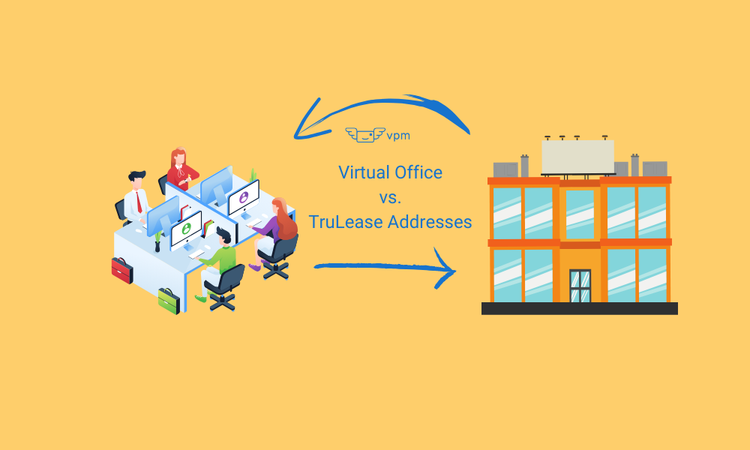
Comparing TruLease vs. virtual offices
Now that you know how TruLease differs from a virtual office, let’s take a look at popular virtual office services and how they stack up when compared to VPM’s TruLease plan.
TruLease
VPM’s TruLease service comes with a physical business address, virtual mailbox, and lease agreement to use for your business. As a bonus, you can have a utility bill added to your plan, allowing you to open marketplace stores (think Amazon or Shopify) with ease.
TruLease does not come with the same amenities that you typically see with other virtual offices, such as a live receptionist, phone number, or conference room. If you don't need anticipate needing these resources, TruLease may be ideal for you.
Pros
- All TruLease addresses are real physical addresses attached to commercial buildings
- Lease agreement
- Utility bill
- Free on-site inspections and call verifications are provided
- 30-day money back guarantee
- Get two separate addresses (mailbox address and physical address)
- Gain access to virtual mailbox services: 24/7 online mail management, mail scanning, remote check deposit, and package forwarding
- Free registered agent service that comes with the mailbox address
- Free unlimited digital storage
Cons
- Only available in 3 states
- 1-year lease agreement required
Regus
Regus offers more than 4,000 business addresses worldwide. In addition to securing a professional address, you’ll enjoy virtual office features like access to a local telephone number, live receptionist services, and mail scanning and forwarding.
Unfortunately, Regus is unable to add a lease agreement or utility bill to any of their plans.
Pros
- All of Regus’ business addresses are physical addresses
- Locations available in every state
- Comes with standard virtual office features: local phone number, live receptionist, and mail scanning and forwarding services
- All plans include the option to use the virtual office in-person 2 days each month
- Short-term contracts are available at a higher monthly cost
Cons
- No lease agreement
- No utility bill
- Registered agent service costs extra
Northwest Registered Agent
Northwest Registered Agent offers a comprehensive virtual office package that includes a professional business address, month-to-month lease, and fully functional virtual phone line with your preferred area code. With locations available in 12 states, you can choose between daily mail scanning and weekly mail forwarding to compliment your remote business.
Since a lease agreement will accompany your business address, this is a viable option for business banking. However, you won’t be able to get a utility bill in the event that further proof of address is needed.
Pros
- All of Northwest Registered Agents’ business addresses come with unique suite numbers and a real office lease
- Amazon Verification Cards are accepted at all locations
- No long-term contract required
Cons
- No utility bill available
- Plans offer same-day digital scanning OR weekly physical mail forwarding, but not both
- Registered agent service cost extra
Alliance Virtual Office
Alliance Virtual Office offers a physical business address along with mail processing and pickup. However, if you wish to add a business phone number and live receptionist to your plan, you’ll have to pay extra.
You won’t get a lease agreement or utility bill with your package, either. Instead, you’ll be provided with an Alliance Address Certification Letter, which may not work when attempting to open a business bank account.
Pros
- All of Alliance Virtual Offices’ addresses are attached to commercial buildings
- Locations are available in many states
- Mail processing and pickup is included in your plan
Cons
- 6-month contract required
- Typical virtual office amenities, like a phone number, live receptionist service, and mail forwarding costs extra
- No lease agreement or utility bill
- Registered agent service is not offered or included in any plans
Starthub Centers
Starthub Centers provides virtual office packages that include a physical business address and virtual mailbox. In addition to the basics, you’ll gain access to amenities like a dedicated phone number, assistance from a trained receptionist, unlimited mail scans with complimentary storage, and mail forwarding.
For those seeking a physical address for proof of address requirements, access to a lease agreement and utility bill is only available with the co-working space package, which starts at a significantly higher monthly price point.
Pros
- All of Starthub Centers’ locations are physical addresses
- Unlimited mail scans, free storage, mail forwarding are included with your plan
- First year of registered agent service is free
Cons
- 1-year contact is required
- Only two locations available: Miami, Florida and Houston, Texas
- To get a lease agreement and utility bill, you’ll need to sign up for their co-working space package
- Access to in-person meeting spaces costs extra
Offix Solutions
Offix Solutions caters to those seeking a professional business address in South Florida. While mail scanning, pickup, and forwarding services are included with the basic plan, it is missing some of the more standard components of a virtual office, like a telephone line and live receptionist services.
However, if you’re looking for a lease agreement and utility bill, you’re in luck. Offix Solutions is willing to provide this.
Pros
- All of Offix Solutions’ virtual office plans come with real physical addresses
- Mail collection, notification, management, and forwarding is included
- Registered agent service is available
- Month-to-month leases are available
- Lease agreement and utility bill available upon request; however, you’ll be responsible for paying for 6 months of service up-front
Cons
- 4 locations are available at this time, all concentrated within the South Florida area
- Access to meeting rooms or in-person office space costs extra
- Telephone and answering services are only available with their higher tier plans
Spaces
Spaces allows you to establish a professional presence for your business by leasing a virtual office. With numerous locations available both in the U.S. and globally, each plan includes mail handling, telephone answering, and call forwarding services. Additionally, select locations offer on-demand access to office space.
While Spaces does offer the opportunity to sign a short-term contract at a more expensive rate, they don’t provide a lease agreement or utility bill with your address. By now, you know what that means… probably not the best choice for business banking.
Pros
- They offer a large network of commercial business addresses
- Packages include mail handling, call forwarding, and live telephone service
- Gain access to networking events
- Short-term contracts are available at a higher monthly cost
Cons
- No option to add a lease agreement
- No utility bill available to your plan
Expansive
Expansive’s virtual office package provides a flexible address solution for business owners. With their most basic plan, you’ll get a professional business address to use in addition to mail receiving services. However, many of their services cost extra (like mail forwarding and electronic mail scanning) and there’s a $99 initiation fee.
Keep in mind that you won’t get a lease agreement or utility bill with either of their virtual office plans, so this isn’t an ideal address solution to open a business bank account.
Pros
- All of Expansive’s locations are physical business addresses
- Choose from locations all over the country
Cons
- 6-month contract required
- Many of their basic amenities cost extra
- No option to add a lease agreement or utility bill
Intelligent Office
Intelligent Office’s virtual office plan, you’ll get a professional business address and virtual mailbox. A la carte services are available for an extra fee, including on-demand meeting rooms and phone, receptionist, and virtual assistant services.
Like many others on this list, they do not offer the option to add a lease agreement or utility bill, rendering it ineffective for business banking.
Pros
- All of Intelligent Office’s locations are commercial business addresses
- Comes with a virtual mailbox
Cons
- Any additional services (i.e. phone, receptionist, hourly office space, etc.) costs extra
- No option to add a lease agreement or utility bill
- They do not offer registered agent services
Venture X
A Venture X virtual office is another option. Their most basic plan comes with amenities like mail and scanning service, live receptionist answering, and access to conference rooms. On the downside, you won’t get a lease agreement or utility bill, so it’s not a great solution for opening a business bank account.
Pros
- All of Venture X’s locations are commercial business addresses
- Locations available in 14 states
- Get access to features like mail scanning and forwarding, a private mailbox, and discounts on meeting rooms
- Month-to-month contracts available
Cons
- No option to add a lease agreement or utility bill
How to choose the right address type for banking
Ask yourself:
- Does the bank require proof of physical occupancy? If yes → prioritize physical address solutions.
- Can I provide supporting documentation? Lease, utility bills, or property records strengthen address verification.
- Is the address tied to a location where the business operates/delivers services? This adds credibility and compliance value.
If your primary need is banking verification, then a document-backed physical address is usually more reliable than a standard virtual office.
| Criteria | TruLease / Physical Address | Virtual Office |
|---|---|---|
| Address Type | Real physical location | Mail/mailbox address |
| Document Support | Lease/utility/physical evidence | Usually limited to mail handling |
| Bank Acceptance | High (meets compliance needs) | Variable (requires verification) |
| Best Use | Banking, compliance, licensing | Business presence, mail forwarding |
| Verification Strength | Strong | Weak to moderate |
Banking on the Right Address: TruLease vs. Virtual Offices
In summary, a virtual office can be a huge compliment to your business if you anticipate needing additional administrative services, like a telephone number or live receptionist. However, it may not be the most ideal choice for business banking. Many financial institutions will reject an address, even if it comes with a lease agreement and utility bill, if they see that it is a virtual office.